

An issue that has plagued Christianity for centuries is the question of whether science and religion can co-exist. Before the Enlightenment in the 17th century, people took the Bible as fact and absolute truth. However, as people started to study the empirical world, a rift started to grow between science and religion.
Why so? Because scientific discovery oftentimes directly contradicts the Bible. For example, Isaiah says that when the Lord comes,
6 The wolf will live with the lamb, the leopard will lie down with the goat, the calf and the lion and the yearling together; and a little child will lead them.
Isaiah 11:6
But, when one looks at the unique anatomy and instincts of animals, this passage seems to contradict the ways in which nature works. In order for a healthy ecosystem to exist, and in order for there to be balance in the world, predatory animals need to eat herbivores. If lions and leopards suddenly started eating grass, their species would be wiped out and lambs and goats would become overpopulated.
In this post, we will look at two parts of the Bible that seem to directly contradict what science says, and try to navigate these issues through scripture. Let’s start at the very beginning, which is a much-debated topic: the creation of earth and the universe.
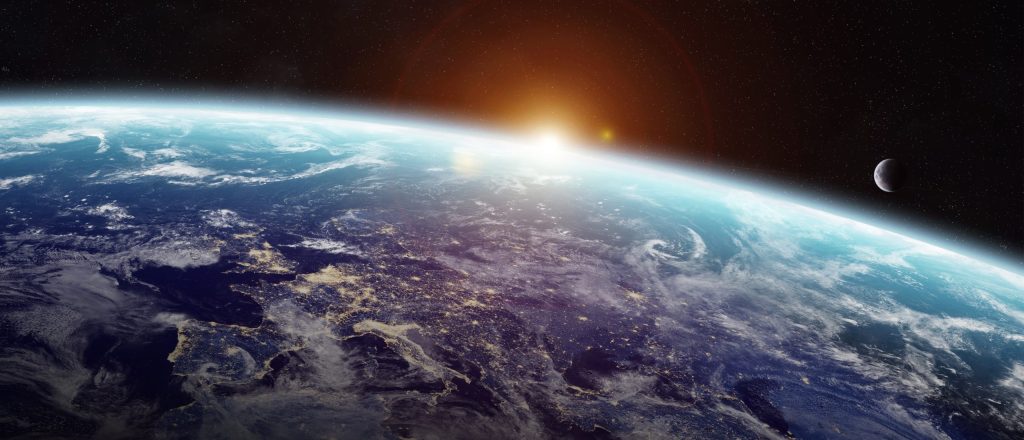
In Genesis, the very first book of the Bible, it famously describes God creating the world in seven days. The Bible also clearly says that God created everything and that nothing simply sprang out of existence:
1 In the beginning God created the heavens and the earth.
Genesis 1:1
The Bible then goes on to explain what God did on each day of creation. On the first day, God made light and dark, or day and night:
5 God called the light “day,” and the darkness he called “night.” And there was evening, and there was morning—the first day.
Genesis 1:5
Then, on the second day, God separated the water on the earth from the water in the sky:
8 God called the vault “sky.” And there was evening, and there was morning—the second day.
Genesis 1:8
On the third day, the Bible says, God made the continents and separated them from the seas. On this day, God also made the plants and vegetation.
12 The land produced vegetation: plants bearing seed according to their kinds and trees bearing fruit with seed in it according to their kinds. And God saw that it was good. 13 And there was evening, and there was morning—the third day.
Genesis 1:12-13
On the fourth day, God made two lights, one to govern the day and one to govern the night. In essence, it is the creation of the sun and the moon:
17 God set them in the vault of the sky to give light on the earth, 18 to govern the day and the night, and to separate light from darkness. And God saw that it was good. 19 And there was evening, and there was morning—the fourth day.
Genesis 1:17-19
Finally, on the fifth day, God created the fish in the oceans, and the birds that fly in the air, and God blessed them to multiply over the earth.
22 God blessed them and said, “Be fruitful and increase in number and fill the water in the seas, and let the birds increase on the earth.” 23 And there was evening, and there was morning—the fifth day.
Genesis 1:22-23
Then, on day 6, God made the mammals and right at the end, human beings. God also blessed all the creatures and humans to multiply and increase in number. Finally, at the end, it says that,
31 God saw all that he had made, and it was very good. And there was evening, and there was morning—the sixth day.
Genesis 1:31
On day 7, God looks at all His amazing creation and rests. The Bible says that,
1 Thus the heavens and the earth were completed in all their vast array. 2 By the seventh day God had finished the work he had been doing; so on the seventh day he rested from all his work. 3 Then God blessed the seventh day and made it holy, because on it he rested from all the work of creating that he had done.
Genesis 2:1-3
what does science say?
Because of these scriptures, many people feel like there is a dilemma between science and religion. The biggest issue is, of course, that according to carbon dating and various scientific studies of the earth and the universe, the earth was created over 4.5 billion years and not merely seven days. The universe is even older: scientists believe that the Big Bang happened around 13.8 billion years ago.
Another issue is scientific evidence of dinosaur fossils. Scientists believe that the dinosaurs roamed the earth for around 150 million years and before them various amphibians and sea creatures. Sharks are one of the oldest species on earth, having existed from over 200 million years ago, and so forth.
This all seems impossible to consolidate, but the Bible does give us some clues on how to interpret these passages. For example, Peter reveals something interesting about how God calculates time:
8 But do not forget this one thing, dear friends: With the Lord a day is like a thousand years, and a thousand years are like a day.
2 Peter 3:8
From this scripture in 2 Peter, we can denote that perhaps the Bible isn’t talking about days as we calculate it, but days as God calculates them. We must also remember that Genesis was given to Moses, who wrote it, as revelation. Moses, like any human being, was not present at the creation of the world. Only a few books later, in Joshua, there is another scientific anomaly.
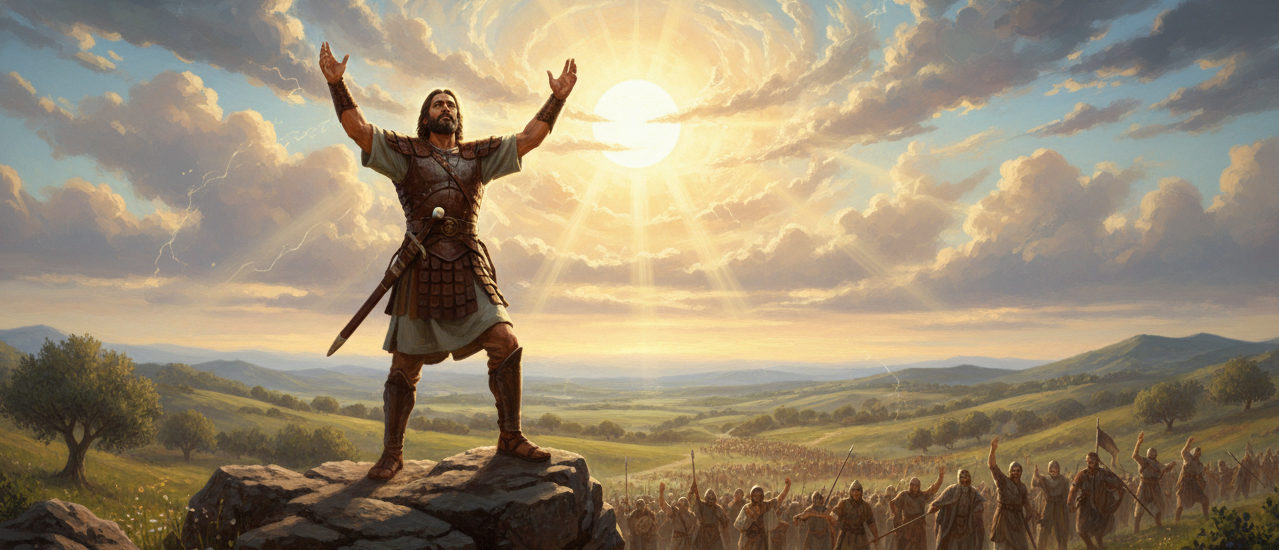
In the book of Joshua, there is a scripture that has riddled theology and caused debate among scientists and religious people for decades. It is the famous story about Joshua stopping the sun:
12 On the day the Lord gave the Amorites over to Israel, Joshua said to the Lord in the presence of Israel:
“Sun, stand still over Gibeon,
and you, moon, over the Valley of Aijalon.”
13 So the sun stood still,
and the moon stopped,
till the nation avenged itself on[b] its enemies,as it is written in the Book of Jashar.
The sun stopped in the middle of the sky and delayed going down about a full day. 14 There has never been a day like it before or since, a day when the Lord listened to a human being. Surely the Lord was fighting for Israel!
Joshua 10:12-14
This miracle is perhaps one of the greatest in the Bible, as it takes place on such a large scale. For any scientist, however, the notion of the sun standing still is ridiculous. As of the 16th century, it is generally accepted that the heliocentric theory is true: the earth rotates around the sun, which is stationary.
Apart from Joshua simply stopping an object that already does not move, the notion of time stopping is pure science fiction. Many scientists might argue that it is impossible for time to stop for one person and not for anyone else, since there is no record in history of a day that has gone missing despite such claims by believers.
Regarding this incident, the Bible gives us another clue on how to interpret such phenomena. In 1 Corinthians, Apostle Paul says something strange:
9 For we know in part and we prophesy in part, 10 but when completeness comes, what is in part disappears. 11 When I was a child, I talked like a child, I thought like a child, I reasoned like a child. When I became a man, I put the ways of childhood behind me. 12 For now we see only a reflection as in a mirror; then we shall see face to face. Now I know in part; then I shall know fully, even as I am fully known.
1 Corinthians 13:9-12
What is interesting about this scripture is that Saint Paul speaks about not being able to see clearly in a mirror. In the 21st century, we have very clear mirrors that are the same as seeing face to face. However, in the Bronze Age, which is when Paul was alive, they used bronze plates for mirrors, which aren’t very clear. From Paul’s context, then, this comparison makes perfect sense.
where does this leave us?
From this discussion, we can discern two methods to consolidating science and religion. The first method is that we must look from God’s perspective and not from our own. The second is that we must read the Bible through the perspective of the time period. The scripture in Joshua took place around 3500 years ago. If we consider it from Joshua’s perspective, we might find that there is a reasonable explanation.