
The issue of fate is as old as time. In John Milton’s Paradise Lost, which is a poem from the Renaissance, God and the Angels have a long conversation about choice. They discuss why God would place a tree in the middle of the Garden of Eden that will cause Adam and Eve to sin.
16 And the Lord God commanded the man, “You are free to eat from any tree in the garden; 17 but you must not eat from the tree of the knowledge of good and evil, for when you eat from it you will certainly die.”
Genesis 2:16-17
Surely God knows that Adam and Eve will be tempted and eat the fruit? Yet, God places the tree in the garden anyway. Adam and Eve fall, they are driven out of Eden, and humankind is cursed because of their choice to eat the fruit.
23 So the Lord God banished him from the Garden of Eden to work the ground from which he had been taken. 24 After he drove the man out, he placed on the east side[e] of the Garden of Eden cherubim and a flaming sword flashing back and forth to guard the way to the tree of life.
Genesis 3:23-24
Even in today’s society, movies, video games, and many other parts of pop culture explore the issue of fate. In The Matrix, Neo has to make a choice that changes his destiny: drink the red pill and continue living in ignorance, or drink the blue pill and learn the truth about humans and the machines.
In Terminator: Judgment Day, Sarah Connor receives a vision of the end of the world and assumes that judgment day is inevitable. That is, until she decides to make her own fate and intervene. Because of her intervention, humankind avoids a nuclear apocalypse.
The future is not set. There is no fate but what we make for ourselves.
Sarah Connor, Terminator 2: Judgment Day
Clearly, even in the advanced twenty-first century, human beings still grapple with the issue of fate. We wonder, is my destiny predetermined? What are the limits of God’s intervention? Where does my responsibility as a human being end and where does God’s begin? In this post we will look at some of the origins of fate and how we got to where we are now.

Let’s travel 400 years into the past. Human beings just got out of the Black Death and the Medieval times. Science has made important discoveries, like the heliocentric theory. It is no longer taboo to dissect cadavers and researchers now use the scientific method.
In the realm of art, Michelangelo and Da Vinci are creating some of the greatest masterpieces like David and the Mona Lisa. Da Vinci is inventing flying machines and other feats of engineering. In essence, human beings are discovering for the first time in 1000 years that it’s great to be human.
I have been impressed with the urgency of doing. Knowing is not enough; we must apply. Being willing is not enough; we must do.
Leonardo Da Vinci
Of course, in religion, there are also revolutions taking place. Geoffrey Chaucer already started criticizing the corruption of the Church in his Canterbury Tales in the fourteenth century. But by the Renaissance, this corruption reached its peak.
Through the selling of indulgences, people no longer needed sincere contrition but could simply buy their time off purgatory. In other words, by giving money to the Church, you could secure your place in heaven.
Your gifts lie in the place where your values, passions and strengths meet. Discovering that place is the first step toward sculpting your masterpiece, Your Life.
Michelangelo
Because of this system, and the overall humanism of the Renaissance, people no longer focused on God. Instead, society started to believe in making their own destiny, which caused them to drift away from faith.
We could even say that this human determinism carried over from the Renaissance and is still around today. Even now, many of us believe that if we work hard, we can be successful, whether God helps or not.

Because of the Renaissance society’s focus on humanism, a great pivot took place. Martin Luther, in the sixteenth century, saw the corruption of the Church and posted his 95 Thesis. In this document, Luther points out all the contradictions of the church and starts the Protestant Reformation.
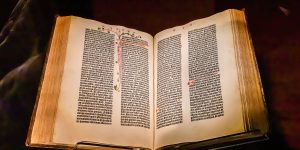
Luther also translated the Bible from Latin into the Vulgate, German. Because of the invention of the Gutenberg Press around the same time, he was able to print and distribute the Bible to the masses. This translation is known as the Gutenberg Bible, which you might be familiar with.
Luther also started a doctrine that John Calvin took further after Luther’s death: absolute predestination. In contrast to the Renaissance belief that humans can achieve anything by their own power and the Catholic practice of buying a spot in Heaven, Calvin said that God has predestined everything. Indeed, there are many scriptures in the Bible that speak about this. In the book of Romans, it says that it does not depend on human effort, but on God:
14 What then shall we say? Is God unjust? Not at all! 15 For he says to Moses, “I will have mercy on whom I have mercy, and I will have compassion on whom I have compassion.” 16 It does not, therefore, depend on human desire or effort, but on God’s mercy.
Romans 9:14-17
In Ephesians, Paul says that we have been predestined to become children of God:
4 For he chose us in him before the creation of the world to be holy and blameless in his sight. In love 5 he predestined us for adoption to sonship through Jesus Christ, in accordance with his pleasure and will—
Ephesians 1:4-5
According to Galatians, God called us even before we were born:
15 But when God, who set me apart from my mother’s womb and called me by his grace, was pleased
Galatians 1:15
In other words, despite humans thinking that we can determine our fate, God is in control of everything. According to this doctrine, God has predetermined our fate for our lives and our eternal destiny as well. No matter what I do on earth, it will not change where I go after I die.

Like the Renaissance idea of human exceptionalism, the notion of absolute predestination has also carried over into modern society. So as twenty-first century humans, we are torn between the two and don’t know where one ends and the other begins.
This is even more difficult for us as believers, because the Bible talks about both God’s responsibility and our responsibility. It seems like God predestined certain things, but that there are many things that are determined by our actions as well. The lump of clay is a good example. The Bible speaks of God’s authority:
21 Does not the potter have the right to make out of the same lump of clay some pottery for special purposes and some for common use?
Romans 9:21
But the Bible also speaks of human responsibility:
20 In a large house there are articles not only of gold and silver, but also of wood and clay; some are for special purposes and some for common use. 21 Those who cleanse themselves from the latter will be instruments for special purposes, made holy, useful to the Master and prepared to do any good work.
2 Timothy 2:20-21
So again, we are left with the same dilemma. Am I in control of my fate, or is God in control of everything? The Bible seems to give us two answers, which doesn’t make it any easier for us. What do you think? Am I in control of my own destiny? Let us know your thoughts in the comments!