
선생 시집 중에
<행복은 온다>라는 시집이 있다.
그중 선생이 겪고서 크게 감명받고 쓴 시가 있는데,
어떤 시인지 아느냐? 맞혀 보아라.
너희들도 그 시를 보면 그러함을 알 것이다.
Among my poetry books, there is one titled <Happiness Comes>.
There is a poem in that collection that I, Seonsang, wrote after experiencing something and being deeply moved by it.
Do you know which poem it is? Try to guess.
When you read that poem, you, too, will see that it is indeed so.
힌트 줄게.
“모두 개구리같이 뛰자.”
뛰어야 목적이 이뤄진다.
I will give you a hint.
“Let’s all leap like a frog.”
You have to run [and leap]* in order to fulfill the purpose.
*(Translation note: The Korean verb 뛰다 means “to run,” but when used to describe a frog’s movement, it means “to jump” or “to leap.”)
그림 봤지?
개구리가 귀가 있냐, 없냐?
개구리가 꼬리가 있냐, 없냐?
You saw the drawing, right?
Does a frog have ears or not?
Does a frog have a tail or not?
그림에 귀와 꼬리는 그렸지만
개구리는 귀와 꼬리가 없기에 색은 칠하지 않았다.
이것 보면 순간 헷갈렸을 것이다. 킥.
Although I drew the ears and the tail, I didn’t color them in because frogs do not have ears or tails.
Seeing this probably confused you for a moment. Keke.
퀴즈도 모두 모두 맞혀 보아라.
‘시’는 계시이고, 시대 말씀이니 잘 봐야 한다.
Everyone, try to get the quiz right, too.
A ‘poem’ is a revelation and the Word of the time period, so you must look at it carefully.
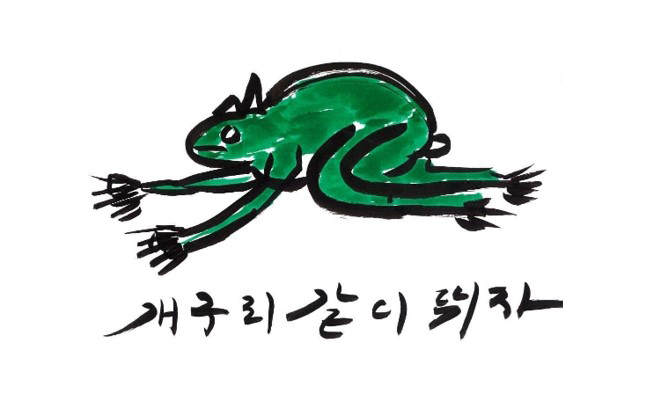
*Image translation: Let’s leap like a frog.